


Summary
- REITs currently offer unattractive yields (3.5%) and negative 10-year dividend growth, making them poor fits for both high-yield and dividend growth strategies.
- Rising interest rates and expensive debt refinancing are pressuring REIT FFOs, while muted rental growth and inflation erode real income potential.
- Historical yield spreads between REITs and Treasuries have turned negative, and mean reversion would require either dividend surges, falling Treasury yields, or REIT price declines.
- In this article, I share more details as to why I firmly believe that the REIT dividend story no longer holds up.
There are two conceptual ways in which investors can devise a dividend investing strategy.
One is about deploying capital in lower yielding companies that offer strong dividend growth prospects. The income effects are back-end loaded andusually this strategy comes with a meaningful price appreciation component as well. The Schwab US Dividend Equity ETF (SCHD
The other one revolves around trafficking into high-yielding securities – i.e., maximizing yield that comes at the expense of income growth (and price appreciation). In this case, there is not a single ETF (or asset class) that could capture the entire universe. Instead, investors have to really piece the puzzle together from multiple parts such as MLPs (AMLP
In my view, REITs don’t fit in neither of these two categories.
Let’s take a look at on of the biggest equity REIT ETFs – the Vanguard Real Estate Index Fund ETF Shares (VNQ
Namely, 3.5% is too low for qualifying into a high-yield strategy, and the dividend growth aspect doesn’t need any commenting from my side.
When it comes to pure-play investments in REITs from an income investing perspective, I see two potential reasons that could motivate investors doing so:
- REITs stepping up their dividend payouts.
- REITs enjoying a significant multiple expansion where the price gains could be harvested and put back at work into other higher yielding opportunities.
Based on what I am seeing in the market now, I simply don’t see how either of these scenarios could happen.
REITs are fighting an uphill battle
Let me first establish a baseline that dictates my thinking here.
Interest rates are likely to move up. I know that it is a futile exercise to try and predict what the Fed will do with the rates, but given how the economic data is evolving (primarily the inflation) it is hard to see how at least one hike wouldn’t happen this year. If we look at what the market thinks, then we will see a consensus on a one rate bump by the end of this year – i.e., 44% odds of 375 bps – 400 bps and 29% of 400 bps to 425 bps (implies 2 hikes).
For REITs it is bad news.
First, higher short-term rates directly increase their borrowing costs. I know that most REITs have fixed their borrowings and developed well-laddered maturity profiles. But still, on the margin it introduces a headwind on the FFO generation. For example, almost all REITs operate with some credit facilities that tend to be tied to SOFR. And Realty Income (O
Second, higher borrowing costs are inherently bad for credit quality. Consumers have to pay more for their outstanding loan balances. The same applies to businesses. On the margin, REIT credit losses (struggling tenant) could deteriorate.
The bigger problem is the what happens with the long-term rates. I have to say that this element is not going in the right direction for REITs:
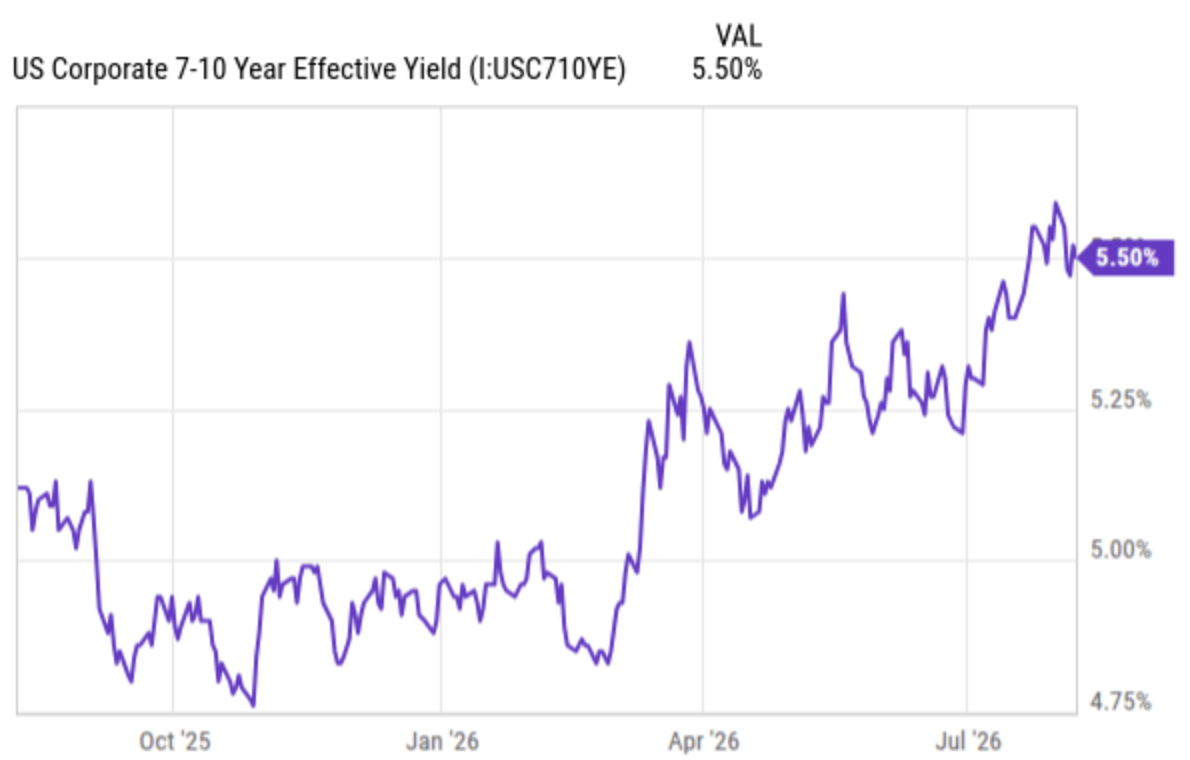
As I said earlier, REITs are heavily dependent on long-term debt financing which makes sense. The idea is to match long duration assets (leases) with long duration debt. However, if these borrowings become more expensive, it means two things: 1) each incremental deal is less accretive provided that cap rates don’t expand (and they don’t, will explain below) and 2) each refinancing event adds a huge layer of additional interest costs.
Again, I will use Realty Income as an example. Take a look at how the interest cost growth has outpaced its FFO growth:
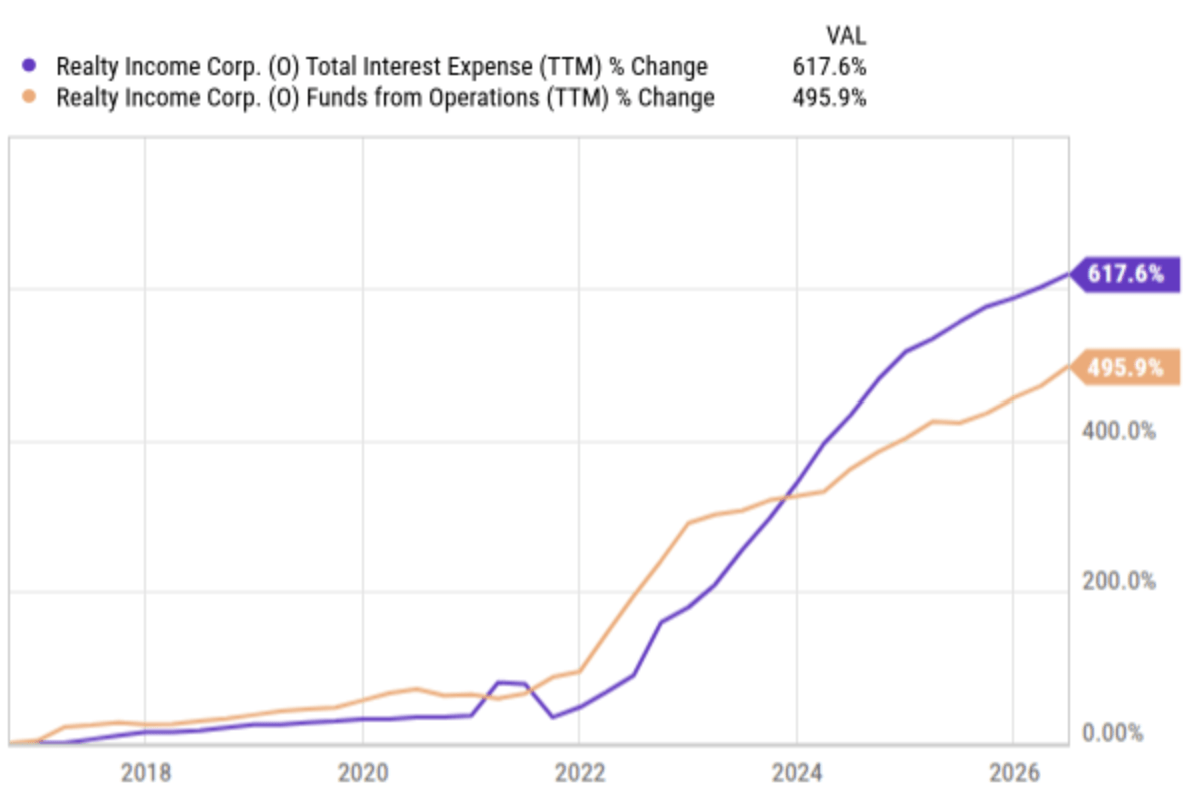
It all has to do with a combination of unfavorable refinancings (debt rollovers at higher rates) and the inability to pass these costs to their tenants because of no pricing power and fixed leases. And there are still many sizeable low fixed rate borrowings that will have to be rolled over the next couple of years.
Realty Income is not alone with this issue. The same could be said about Agree Realty (ADC
There are two things that could improve the situation (apologies for segmenting everything in two parts):
1) Strong lease growth.
A year-over-year retail rent growth has been slowing down since mid-2022. In Q1 2026, the retail rent growth landed at just 1.9%. The U.S. industrial rent growth has recently averaged between 0.8% and 2.1%. For apartments the growth is even smaller.
If we couple this with 3%+ CPI prints, then basically we get a negative real growth and REIT cost base (general and administrative) that grows faster than their top-line figures.
2) Falling long-term yields.
I don’t have a crystal ball and macro is not my cup of tea. However, let me list some key elements that make me think that the long-term yields will remain elevated (or are likely to keep going up):
- The U.S. fiscal deficit is huge and getting bigger.
- We see more and more signs of deglobalization, which imposes a structural pressure on costs (no longer cheap outsourced labor, tariffs, reshoring etc.).
- A significant increase of supply in long-dated bonds by AI players.
- The inflation fears seem to be more less transitory than initially thought – e.g., war in Iran.
Take a look at the following chart:
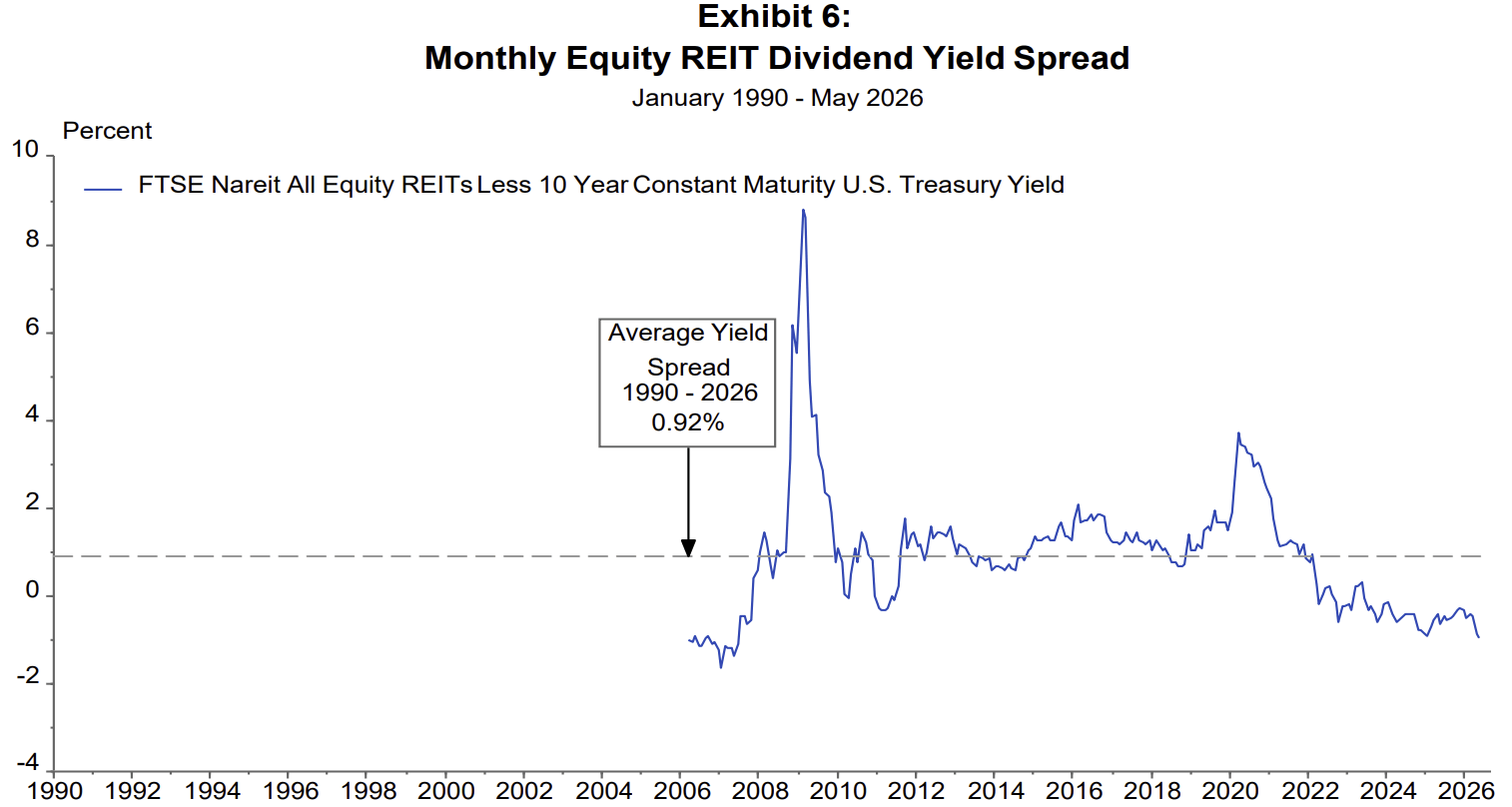
Here we can see the historical relationship between REIT yield and the U.S. 10-year Treasury yield. Historically, REIT investors have been compensated in the form a positive yield spreads relative to the Treasury. Now, the situation has diverged from the norm, and in a negative way. If we believe in mean-reversion (I do), then there are three way how this situation could be solved: 1) REITs deliver massive dividend increases, 2) Treasury yields fall or 3) REITs plunge which would mathematically make their yield higher
Given what I outlined, I don’t believe in first two scenario.
The bottom line
I don’t see a merit of allocating notable portions in REITs if the objective is to build up a decent income machine. Frankly, I don’t see a strong total return case in REITs either. The FFOs are subject to headwinds from expensive debt refinancings and interest rates that aren’t going in the right direction. The underlying growth is not robust enough to offset these pressures. The only instance that could quickly turn things upside down (in a positive way) is if the long-term yields drop. Currently, I don’t view this as a realistic scenario.
So, when it comes to REITs, we have to be extremely selective and probably even innovative as to how the REIT factor is captured. In my humble opinion, REITs with a covered call overlay component could be a solution. Covered call solutions offer higher dividend yields (via option premium) by selling the implied volatility, which can only come back to haunt if the underlying securities exceed option strike values. In this case, I would suggest that investors consider the NEOS Real Estate High Income ETF (IYRI
Photo by Mick Haupt