


Summary
- The S&P 500’s dividend yield is near historic lows, reflecting a shift toward capital-intensive tech companies and increased market uncertainty.
- I focus on total return over dividends, as reinvestment in growth often outweighs immediate shareholder payouts for long-term investors.
- Low dividend and buyback yields signal increased risk and stretched valuations, with the S&P 500 trading above its historical average multiple (partially justified).
- Shareholder yield is subdued; we could see it as a cautious signal; higher dividends or buybacks would help de-risk portfolios amid current uncertainties.
Recently, I saw a very curious chart. It showed that the market’s dividend yield (indexes such as S&P 500
And that is true. As you can see below, we are talking about SPY (
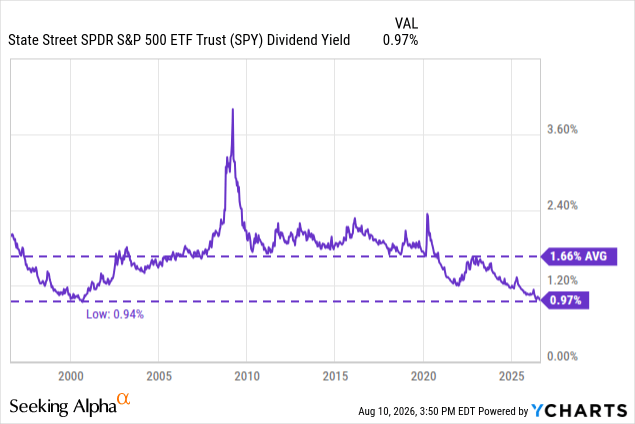
Of course, there are many questions to be asked based on this factor alone. Are the S&P 500 (SP500
As usual, there is no direct and obvious answer; there are many nuances to be analyzed. The profile of companies has changed in recent years; the “moment” of these companies has also changed in recent quarters, and the dividend yield does not tell the whole story about the shareholder return (we should also consider buybacks and earnings growth).
Why I Have Mixed Feelings About Dividends
First, I need to mention the reason why I care “a little less” about dividends compared to the average investor. In theory, dividends matter almost zero in a company’s valuation. The “value” is directly linked to future free cash flow; i.e., it matters little whether the company will distribute 50% of its net income as dividend yield in the first years, or spend 50% of its net income in buybacks, or retain 100% of net income in cash and equivalents.
In fact, when we are talking about good companies and the long term, it makes even more sense for that company to distribute fewer dividends. Let’s consider Amazon (AMZN
You could argue that the shareholder could also have a good capital allocation, and that’s true; but that is also “not guaranteed,” perhaps less guaranteed than a good company allocating capital. An example is Meta (META
In short, in my view, the long-term investor needs to be much more concerned with total return than with dividends. If you are investing to collect returns 10 or 20 years from now, the recent dividend yield should matter almost nothing compared to the dividend yield potential in 2036 (which would be boosted if the company was investing more instead of distributing dividends).
However, that is not the full story. I recognize that many people need dividends for the next 12 months, so that is an important caveat here. Another very important point is that I don’t mean that I think dividends are a bad thing; in fact, I think dividends are a good thing; they show that the company has a healthy cash flow and balance sheet (most of the time) to the point of being able to maintain a solid and consistent dividend yield.
But this point is cliché. Everyone knows that dividends are common in mature and generally solid companies. However, a point that—in my view—is greatly overlooked, and that makes a lot of difference in the current market, is how these dividends are able to mitigate uncertainty, which I will explain in the next section.
Why I Think Dividends Still Matter In This Market
Below, we have the largest holdings of the QQQ ETF. Note that we have some “new” names such as Micron (MU
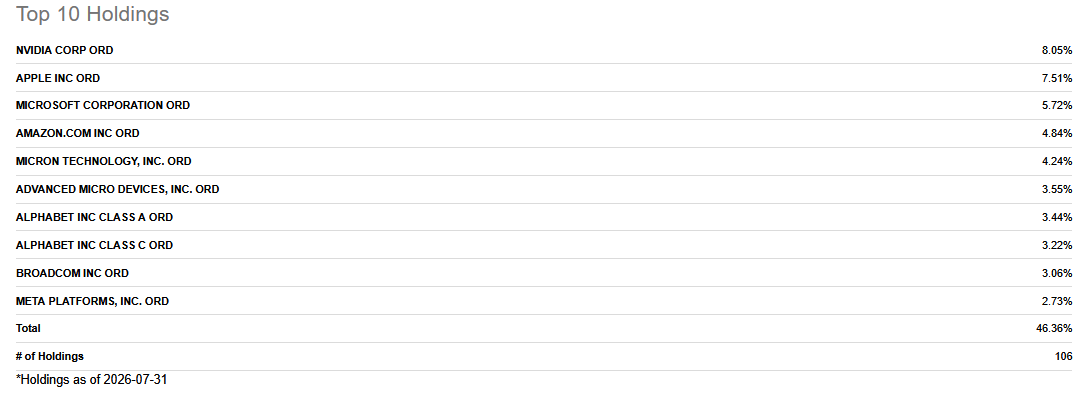
The S&P 500 is also not so different. Nvidia represents 7.55% of the ETF, while Amazon, Alphabet (GOOGL
And this connects directly with the point of how dividends could mitigate the uncertainties of this market. We’re talking about an index that is highly concentrated in technology, and even though they are different companies, hyperscalers depend directly on trends such as cloud and AI to play out. Semiconductors are also directly connected to this trend.
Many of these companies are at a capital-intensive moment. Alphabet, for instance, posted its first negative free cash flow recently. Micron, in its last quarter, invested $7 billion in CapEx.
Let’s take Micron as an example. Management expects a $27 billion CapEx in fiscal year 2026; also, they’re going to “increase substantially CapEx next year.”
Let’s say hypothetically that Micron, which is generating ~$25 billion in operating cash flow per quarter, will be able to generate $1 trillion in cash flow over the next 10 years (made-up figure to prove my point). This value is already larger than its market cap, which means if the company distributes 100% in dividends and the price stays flat (keeping revenue, margins, and multiples stable), the total return would be more than 100%.
Good, right? But what if Micron spends $500 billion in CapEx in this period? Now we have a 50% total return. Of course, in theory this shouldn’t happen, since $500 billion in CapEx needs to give some level of return, whether to substantially increase production capacity (and consequently increase revenue) or at least make operations more efficient and improve margins. But my point here is about uncertainties. The $500 billion in CapEx that Micron will invest over the next 10 years (in this hypothetical scenario) could yield a return or could be a fiasco, especially given the volatile scenario in memory demand. Maybe the company will be increasing its capacity and price/demand/supply will normalize in 2028-2030, and then Micron will have more capacity, more costs, and less pricing power (and less demand and less revenue).
So what would happen if Micron generated ~$100 billion in cash flow over the next 12 months and distributed 100% to the shareholder? Simple, the risk would be mitigated. Because it would decrease the risk of oversupply, but also because the shareholder would have already cashed in a dividend yield of more than 10%, i.e., even if the stock drops to $0, the total return wouldn’t be -100%.
The same rationale works for hyperscalers; if Alphabet were investing “only” 50% of its operating cash flow in infrastructure and distributing 50% in dividends, the risk and uncertainty would be way lower.
In short, I am not giving this example to say that Alphabet shouldn’t expand infrastructure or anything like that; I’m just saying that in the current market, more dividends could help reduce the feeling of uncertainty.
But It’s A Different Moment
The entire section above already brings up some points that justify the reason why the dividend yield is low.
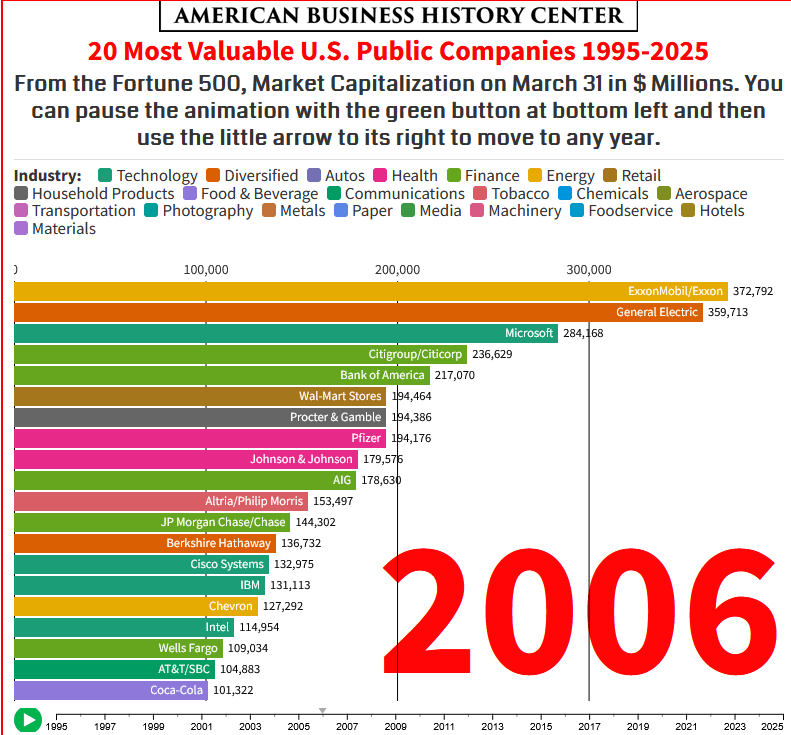
The first is that a large portion of the index is composed of tech companies. Advanced Micro Devices is not at a mature stage ‘enough’ to pay dividends. Even companies that are already at more advanced stages, like Alphabet and Amazon, still see a lot of opportunity to invest.
It is completely different to compare the current dividend yield with the dividend yield from 10 or 20 years ago for this reason. In 2006, the largest US companies were consumer staples, banks, and oil companies, such as ExxonMobil (XOM
Other than that, dividend yield is definitely not the full story. Apple (AAPL
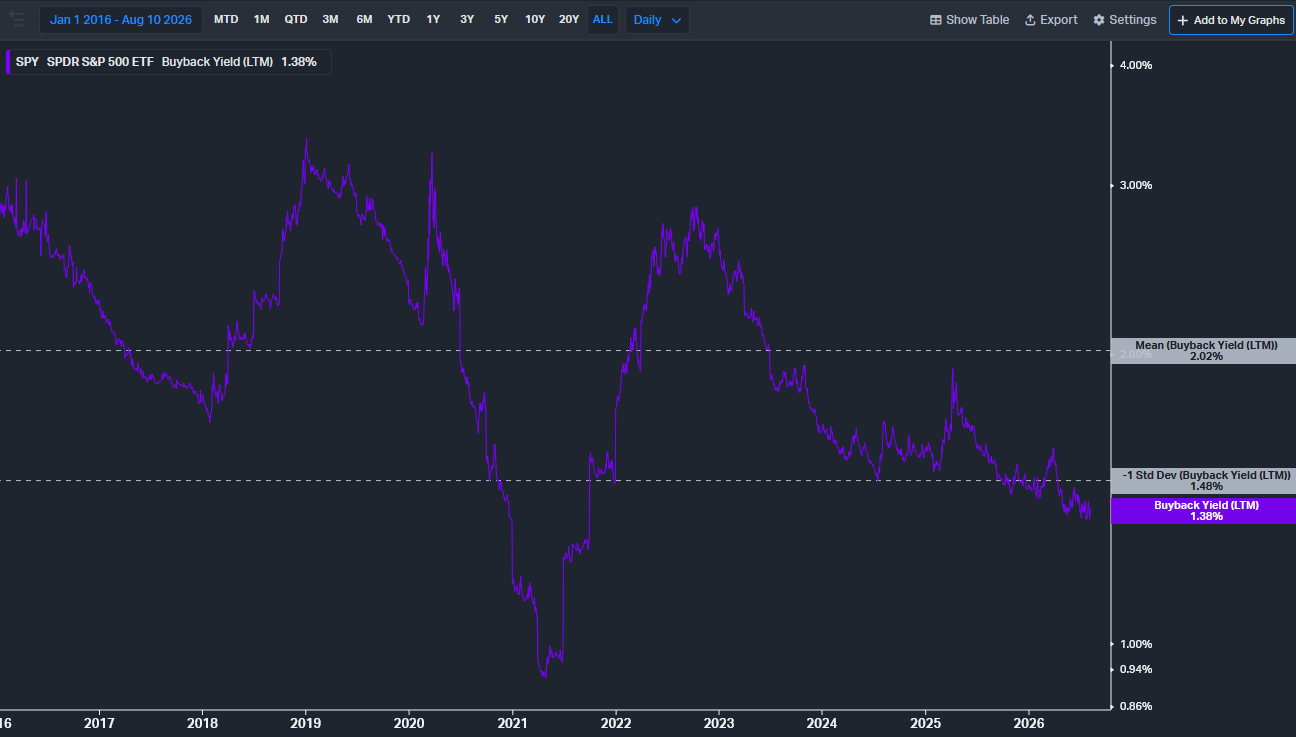
By the way, the S&P 500’s buyback yield is at 1.38%. So the shareholder yield is a little above 2%; it’s not great, but it isn’t a disaster either.
Bottom Line: Still A Signal
Although I am not bearish on U.S. equities, I believe that this lowest dividend yield is a signal and not noise. The buyback yield is also at low levels, which means shareholder yield is at a lower level compared to recent years. This is a reflection that the index has changed and that the companies’ momentum has also changed, but it is also an indication that the valuation is not “great.”
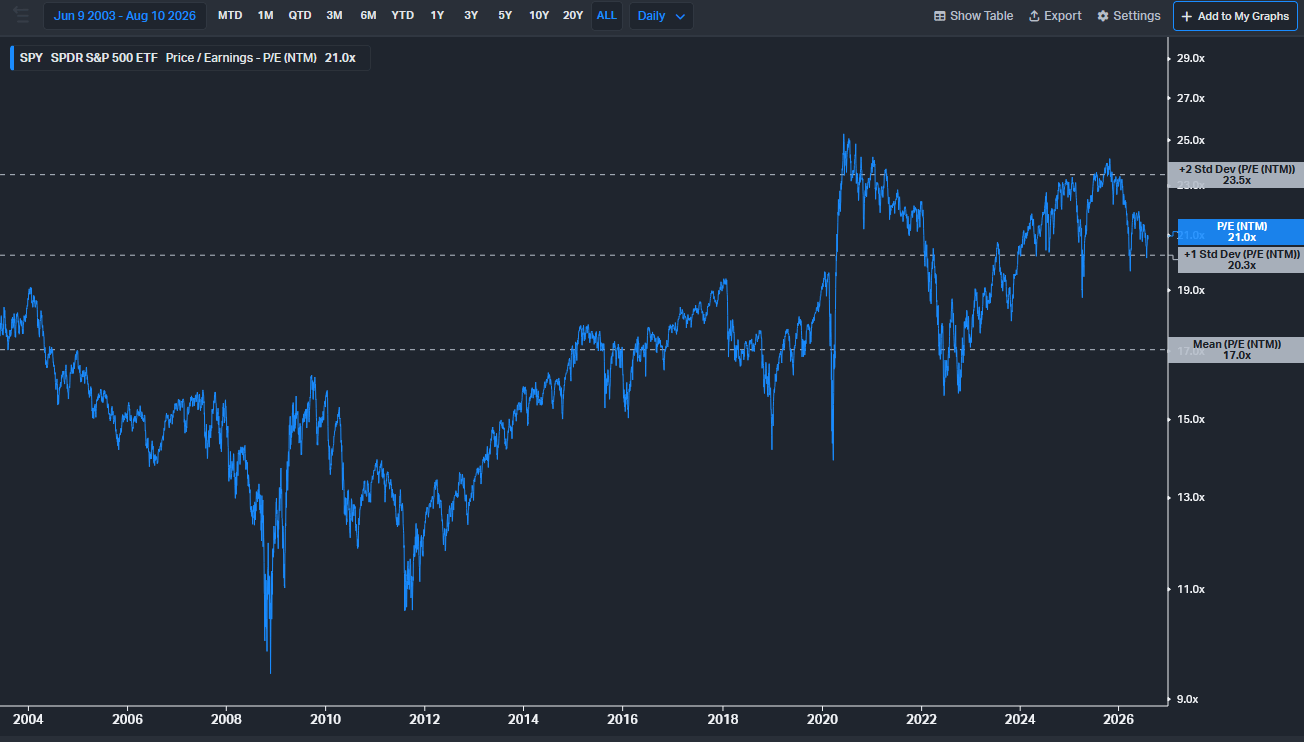
Given the context, I wouldn’t say that the ~21x forward earnings for the S&P 500 are overvalued; many companies (MSFT, NVDA, GOOGL, AMZN) are growing a lot and are driven by great trends. But still, this multiple is above the avg. and also one standard deviation above the avg.
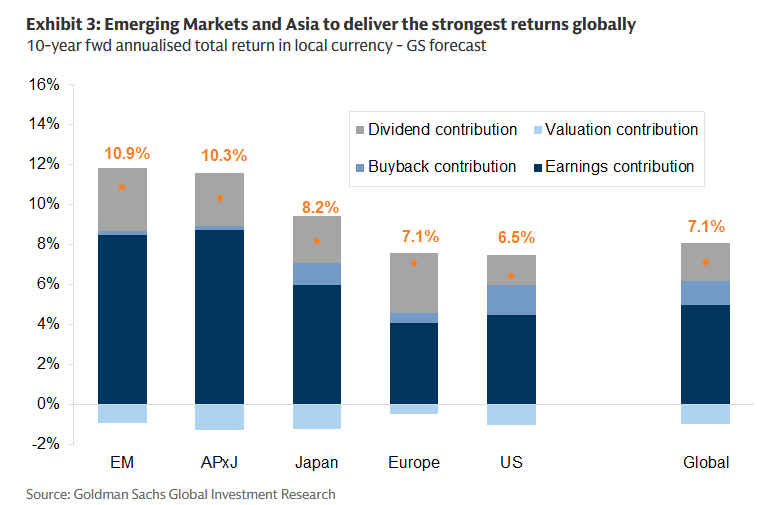
Goldman Sachs’ forecast supports this more cautious vision. Dividend yield + buyback yield should contribute positively to the return in the coming years, but the main driver should be earnings growth. On the other hand, valuation (multiple) should be an obstacle. It’s worth mentioning that this forecast is from the end of 2025, i.e., the multiple was slightly worse, but the buyback yield and dividend yield were higher.
In short, I see this low dividend yield in general as a signal to increase caution. A higher dividend, or even a higher buyback yield, would be a good tool for a “de-risking” in this market of greater uncertainties. So, although I see that it makes sense to have a lower dividend yield (to increase CapEx) and that this should be analyzed with all necessary nuances, I also believe that we’re seeing an increase in risk—the investor is paying a higher price but accepting a lower “shareholder yield” in order to try to capture a higher return in the coming years (with some high level of uncertainty in some segments of the indexes).
Personally, I prefer to continue following my strategy. I’m still investing in companies that I believe have a lot of potential in the coming years or decades (you can see some in the disclaimer below, such as GOOGL and AMZN), but I also diversify my portfolio so I’m not overexposed to hyperscalers (for instance, I also hold positions in Brazilian stocks, fixed income, and others).
Photo by Markus Spiske