


Summary
- The yields that we can find in today’s market look relatively high.
- Yet adjusted for inflation, the situation quickly becomes less attractive.
- And the issue is that for retirees, the inflation that matters most is running hotter than what the headline figure might suggest.
- This creates multiple consequences.
- In this article, I flesh out the underlying problem and share practical examples of how to not get burned and also how to navigate around it.
I bet that many income investors are relatively satisfied with the yield levels that can be accessed through various market channels. While we don’t have the same luxury as during the pandemic or in the immediate aftermath of it, the average yield that we can get from somewhat solid instruments is certainly much higher compared to the pre 2022 period. I remember how back in 2019 I was evaluating Realty Income Corporation (O
However, I am not sure that I am happy about the current opportunity set within the high-quality yield complex. I would even take one step further and argue that the prevailing conditions from a dividend and retirement income investors’ perspective are almost as challenging as in the ultra-low-interest rate era.
Inflation hurts more than you know
If we take a step back and ask ourselves what the main objectives of an income-based strategy are, then I guess we would share an agreement on the following three concepts:
- Receive sufficient portfolio income to cover all living expenses and, for obvious reasons, do so with some margin of safety (surplus).
- Preserve the purchasing power of the portfolio cash flows so that the dollar we get from the portfolio today (or upon retirement) can buy the same amount of goods and services and at the same quality.
- Generate positive wealth in terms of real income from each incremental dollar deployed in the portfolio.
To achieve these objectives, we are effectively taking a couple of important battles. Some of them are directly conflicting with each other.
Consider this.
We have to make sure that the portfolio income machine can be trusted in the next 20, 30, or 40 years in the future. In other words, we have to avoid unexpected dividend cuts and permanent NAV erosion events.
At the same time, we have to ensure that the yield we buy and maintain in our portfolios exceeds inflation to, among other things, preserve the purchasing power and make the most efficient use of our capital.
The conflict lies in the fundamental truth that true dividend durability tends to come with unattractive dividend yields that can be below inflation.
And in this context (regarding inflation), I have done some number crunching that has translated into quite a harsh reality. In the table below, I have built some broad numbers based on the last 6 years of inflation data, using the U.S. Bureau of Labor Statistics database. Given that July 2026 is the latest available print, I have calculated the yearly averages and cumulative figures using the TTM periods that are based on July readings.
The cumulative Jul 20–Jul 26 column measures the cumulative inflation for a July 2020–July 2026 period. The annual average 3-year TTM column reflects the mean value of the annual inflation results for the July 2023 – July 2026 period. Finally, I have split the table into three parts: 1) headline CPI to show what the general statistics indicate, 2) a selection of 5 retirement-relevant items to see their realized inflation rates, and 3) a selection of 5 retirement-irrelevant items to see their realized inflation rates.
So, the real inflation that is relevant for investors, who simply want to enjoy a balanced retirement, is, arguably, higher than what the headline figure suggests. For example, I can’t imagine myself buying new electronic devices and clothing each year or going to universities when I will be living off my portfolio income. What I can imagine is me paying utility bills each month, driving my car, and perhaps buying a pet. The latter category has inflated at much higher rates than the headline figure.
Consequences for income investors
One of the key things that income investors have to understand is that in order to create new wealth on an inflation-adjusted income generation basis, the minimum (hurdle) yield has to start from ~5%. And this would be still conservative as it would warrant a break-even of inflation and offer no margin of safety to account for potential hiccups down the road.
There could be some rare exceptions whose dividend growth prospects might justify lower entry yields. The Schwab US Dividend Equity ETF (SCHD
However, there is a plethora of asset classes or specific instruments that simply can’t deliver what is necessary for truly income-oriented investors.
This includes most equity REITs, which yield around 3% and have been producing below-inflation-level dividend growth for years. The Vanguard Real Estate ETF (VNQ
In the chart below, I have reflected some of the most popular dividend investing household equity REIT names and their cumulative dividend growth statistics starting from July 2020 so that we could contextualize these results with the numbers presented in the table above:
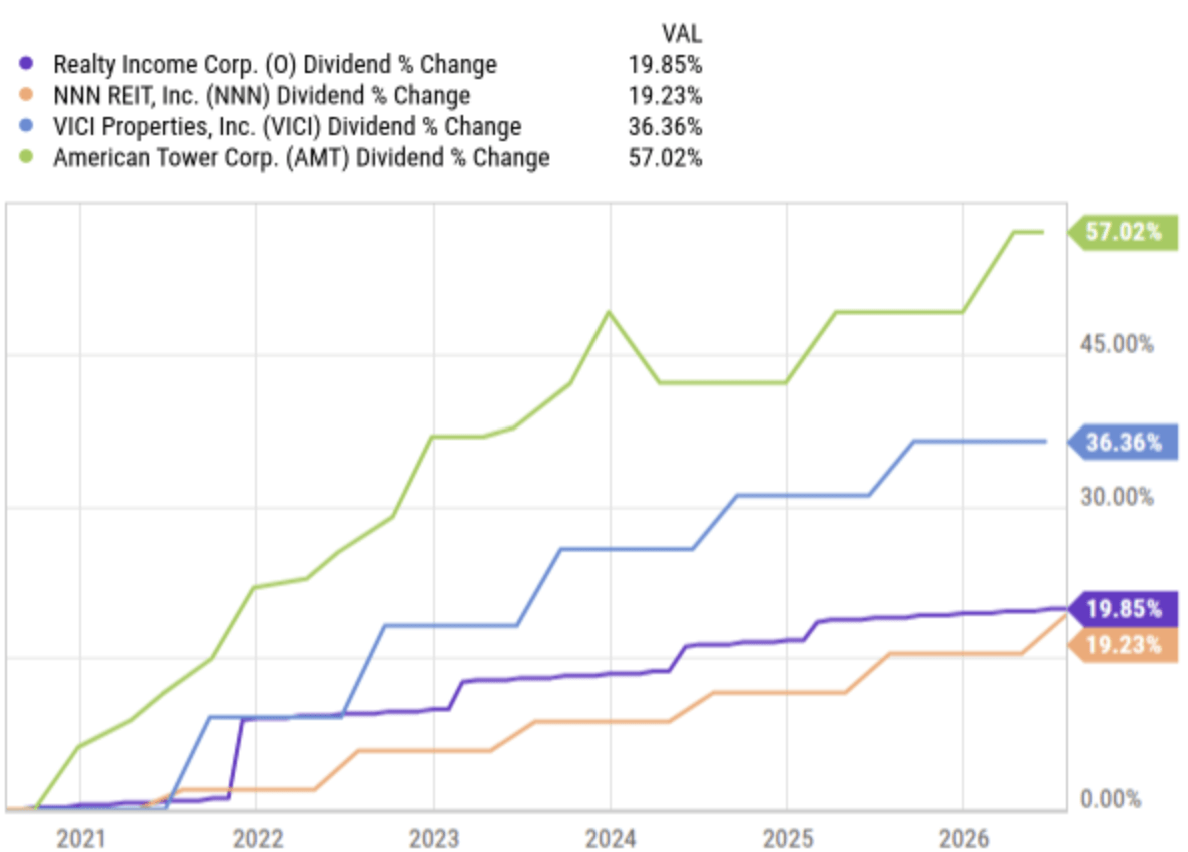
All of them have grown their dividends at a slower pace than how the (retiree-relevant) inflation has moved up. American Tower Corporation (AMT
The same could be said about telco stocks such as Verizon Communications Inc. (VZ
For tobacco, the same thing. Stocks like Philip Morris (PM
Long-dated investment-grade bonds or Treasuries (TLT
As you can see, many investment areas simply don’t make sense anymore if the concepts that I shared above (early in the inflation section) have to be fulfilled.
I see only one way out of this issue, which is about tilting portfolios to high yielding instruments so that the weighted average portfolio yield would land at 7% (at minimum). From these levels, investors could surpass the inflationary headwinds right from the get-go and have some firepower for meaningful reinvestment that could feed incremental growth (or at least offset potential dividend cuts)
As I have elaborated in some of my previous articles, BDCs (BIZD
The bottom line
The current headline inflation is unfavorable. An annual 3% cost inflation can, over time, compound to something really tangible and expensive. However, the real issue is much worse. If we strip out goods and services, which for most folks don’t play as important a role as, say, utilities and vehicle maintenance, the real headline figure would be meaningfully higher.
To be prudent and realistic, I would suggest that investors assume 5% as an inflationary headwind that has to be surpassed by incremental income generation just to maintain the current standard of living (or purchasing power).
This, in turn, means that most asset classes fall out of income-oriented investor portfolio equations. For example, equity REITs, telcos, and long-dated high-quality fixed coupon bonds are the obvious choices to avoid (sure, there are some exceptions out there).
Instead, the focus should be shifted towards higher-yielding instruments or products that offer really significant dividend growth prospects. The former is an area of my focus. And this area largely consists of high-quality BDCs, MLPs, value-oriented covered call ETFs, CEFs, and preferred share funds.
Photo by Towfiqu barbhuiya Unsplash