


Summary
- Research shows REITs outperform private real estate by 2–4% annually, with less risk and effort.
- Yet, investors will often favor private real estate due to many misconceptions.
- Here is what investors get wrong about REITs.
- High Yield Landlord members get exclusive access to our real-world portfolio. See all our investments here »
I believe that REITs (VNQ
This is not just my opinion.
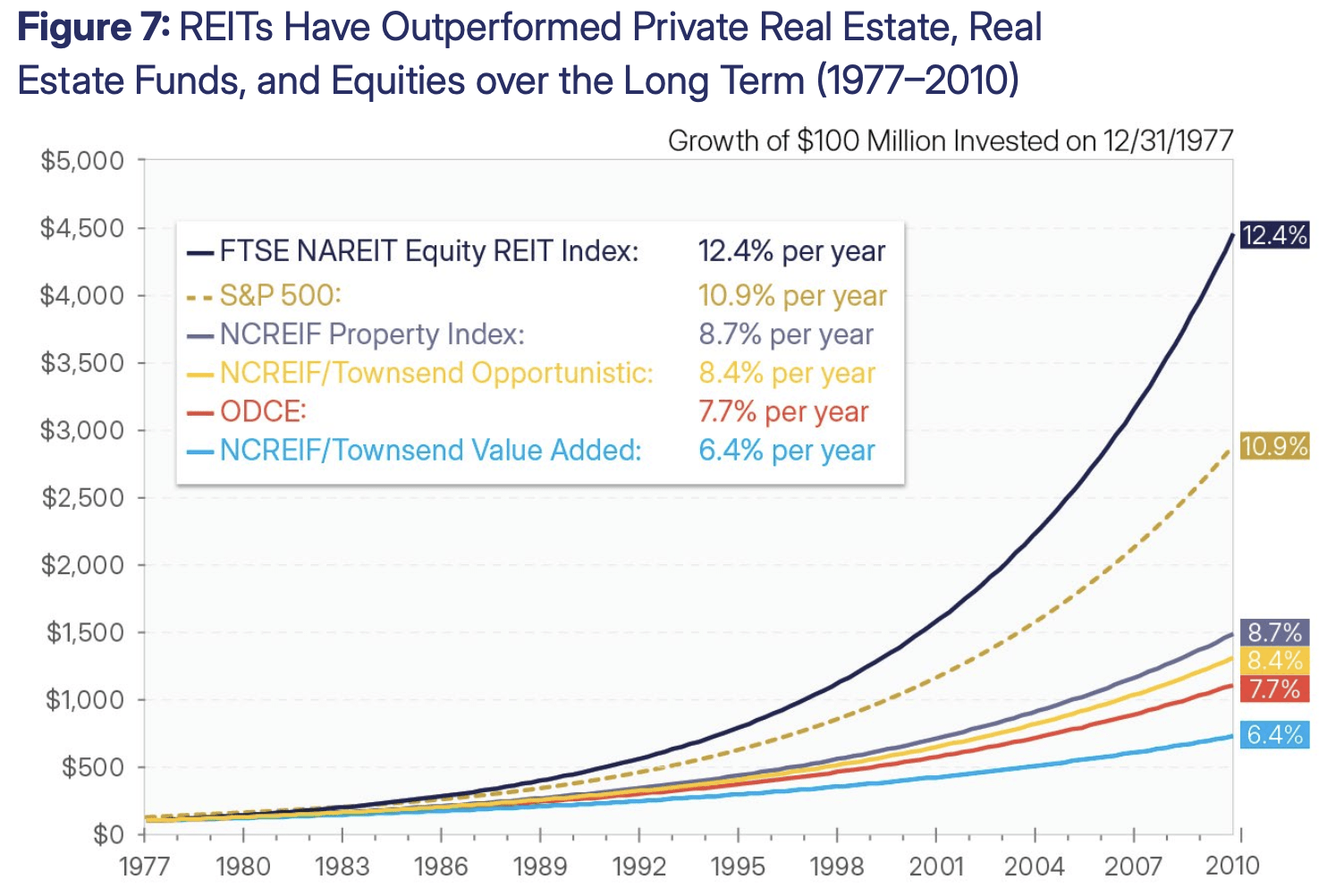
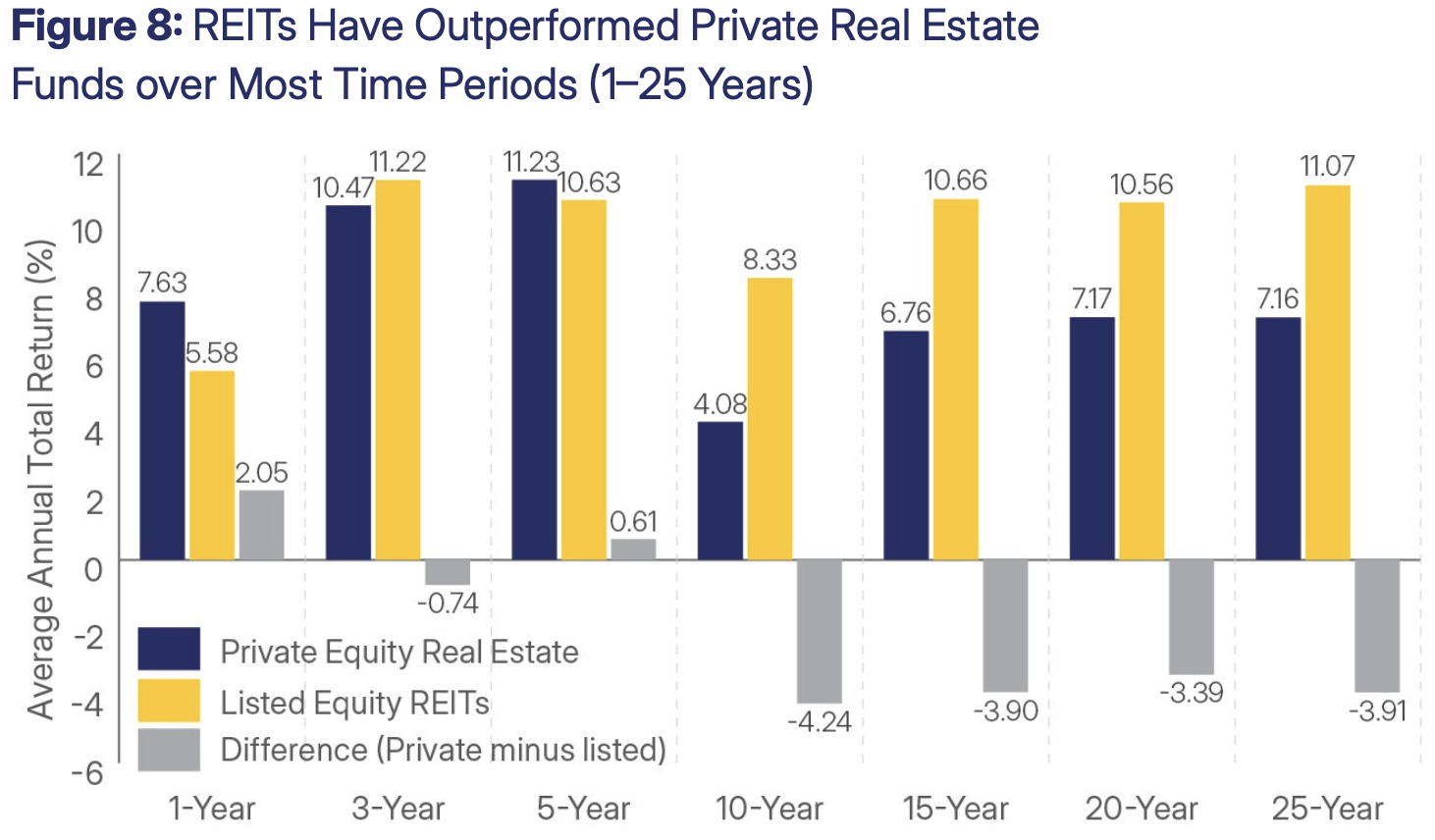
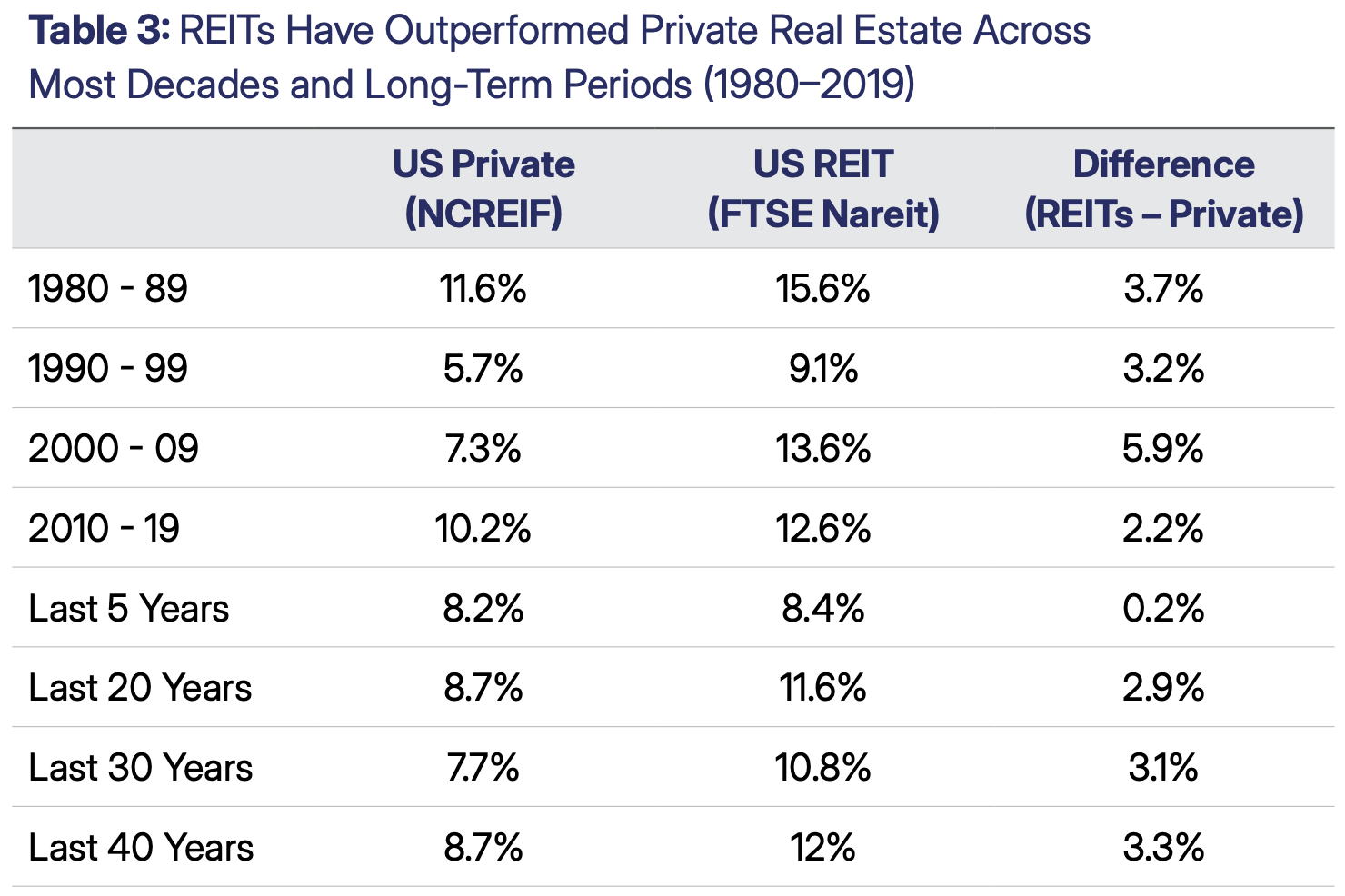
There are many studies that compare the returns of REITs vs. private real estate, and the results are unanimous: REITs outperform by 2-4% per year on average:
Normally, higher returns come with higher risks, but this is not the case here.
REITs are public, liquid, diversified, conservatively financed, and professionally managed companies with significant scale and no liability risk for investors.
Private real estate investments, on the other hand, are private, illiquid, concentrated, aggressively financed investments that rely on DIY or external management with significant conflicts of interest and come with substantial liability risk.
Even worse, despite generating lower returns with far higher risks, private real estate investments also require far more effort, limit your freedom, and could hurt your career and lifestyle.
So based on that, I would argue that it makes no sense for most investors to favor private real estate over REITs.
Yet, that’s still exactly what’s happening today.
Most investors stay away from REITs and invest in rental properties instead. I think that this is because of a few very common misconceptions about REITs that hurt their market sentiment.
Here is what real estate investors get wrong about REITs:

Misconception #1: No Leverage Benefits
One of the main reasons cited for favoring private real estate over REITs is that they supposedly don’t enjoy the benefits of leverage.
Real estate investors will argue that with just $50k, they can buy $100k or even $150k worth of real estate using a bank’s money, whereas with REITs, $50k only buys you $50k worth of REITs.
This argument is used all the time in comparisons, yet it is fundamentally incorrect.
What all these investors ignore is that what you see traded on the stock market is the equity value, not the total asset value. Therefore, when you are investing in REITs, you are directly investing in the equity component. It is equivalent to the down payment you are making when buying a property.
REITs themselves then add debt on top of your equity in order to leverage it and earn higher returns for their shareholders. In that sense, the $50k invested in REITs may be controlling $100-150k of real estate, but you will only see the value of the equity ($50k) traded on the stock market, and that’s what confuses investors. It is the same as if you only monitored the value of your down payment when investing in private real estate.
But fundamentally, it is the same thing. Both benefit from leverage. There is no advantage here for private real estate. Nearly all REITs use debt on top of their equity to boost returns. In many cases, REITs may even be able to better leverage your equity because their large-scale and public listings give them better access to capital at a lower cost. They may, for example, use some preferred equity on top of regular debt to further increase leverage in a risk-mitigated way. Even better, since investors do not themselves take the debt, they are never personally liable for it and do not need to pay loan origination fees. This allows REIT investors to enjoy the benefits of leverage with lower risk and cost.
In short, it is just a misconception to think that REITs don’t enjoy the benefits of leverage. Of course, REITs wouldn’t make sense if investors had no leverage benefit, but this is not the case.
Misconception #2: Miscalculated Returns
I often see investors claim that they earn 20, 25, or even 30% annual returns from private real estate investments. They then compare these high returns to the more typical 10-15% annual returns of REITs and quickly conclude that REITs are not worth their time.
In reality, in the vast majority of cases, investors are simply miscalculating their returns.
Warren Buffett became the richest investor on earth by compounding at 20%, so it is hard to believe that non-professional investors are casually earning higher returns by buying rental properties as a hobby.
The reality is that real estate is a low-margin business with low barriers to entry. Therefore, if such high returns truly existed in private real estate, then a lot more capital would flow into these investments, pushing prices to the point where future expected returns dropped to a more adequate level relative to the risk profile of these investments.
The actual returns are much lower, and investors are miscalculating their returns in two ways:

First, they will commonly cite the returns of a typical good year and think those are representative of their average annual returns over a full cycle. In reality, real estate returns are bumpy and cyclical. You may earn 20% annual returns for three years in a row, just to then lose half of those returns in year 4 when your heating system breaks down and needs to be replaced. Returns are also cyclical. During most years, returns will be steady, but when a downturn occurs or real estate becomes oversupplied, property values can easily drop 10%, resulting in a 20-40% drop in your equity value, again erasing years of returns.
Once you properly account for all the larger but infrequent capex investments and look at returns over your full cycle, the average annual returns drop significantly.
Second, investors will assume that their labor is free. They will work countless hours on a single property just to find the right deal, to negotiate it, finance it, renovate it, and then manage it, and assume that all of this time and labor has zero value.
In reality, they could have used all this productive time to work another job, earning them income, and/or start another business.
If investors deducted, say, $30 per hour of work, they would realize that a big chunk of their returns comes from their own labor and not their “passive” real estate investment.
Adjusted for these things, real estate returns drop to much lower levels than what’s commonly claimed online, and REITs outperform in part because they enjoy huge economies of scale in not just their management but also property maintenance, brokerage, legal, and every other cost item.
Misconception #3: No Consideration for Career Risk
This one truly baffles me. Your number #1 priority on your wealth-building journey should always be your career because that’s ultimately what will determine your earning power and your capacity to save and invest to attain financial freedom.
Therefore, if your goal is to build wealth, you should stay away from activities that could potentially slow down your career progress.
But that’s exactly what buying rental properties will do. It will take away a lot of your time, attention, and energy. It will be a major distraction, causing you to lose focus at best and nights of sleep at worst. It is work-intensive and stressful. Even worse, it will tie you down to a specific location because taking a new job opportunity in another city would mean leaving your properties and local market knowledge behind.
This will ultimately lead to slower career progress. You won’t enjoy the same flexibility to take on new opportunities and will be less focused at work, allowing others to take the lead.
This will have a far greater negative impact on your wealth-building journey than potentially earning an extra 1-2% return by investing in rentals.
Misconception #4: Not Tax Efficient
Many rental property investors also imagine that private real estate investments are far more tax-efficient than REITs.
I will keep this one short because I have written a separate article debunking this claim. You can read it by clicking here.
In short, REITs are incredibly tax-efficient as they pay no corporate tax, often retain a big chunk of their cash flow (taxed at 0%), classify distributions as return of capital (taxed again at 0%), focus more on lower-yielding properties with faster growth prospects (growth is tax-deferred), and have the scale to better contest property tax hikes. Investors also enjoy a 20% deduction on the taxable distributions, do not suffer any property transfer taxes or any other sorts of transaction costs, and can place REITs in tax-deferred accounts.
Investor Takeaway
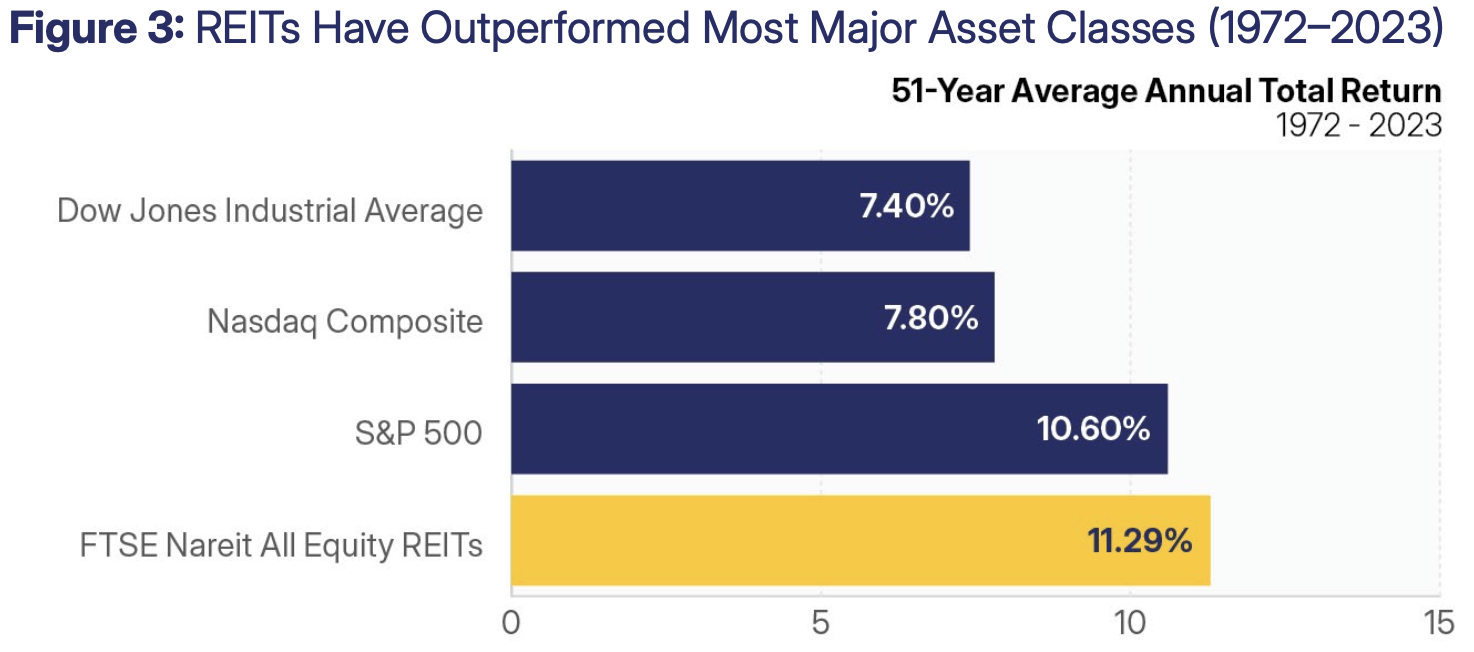
REITs have generated some of the very best returns in the financial market over the long run, outperforming private real estate, the S&P 500 (SPY
Even then, a lot of investors make the mistake of investing in private real estate, often due to these misconceptions.
There are exceptions, of course, but in most cases, it results in lower returns with higher risk and greater efforts, in my opinion.
For these reasons, we favor REITs nine times out of ten at High Yield Landlord.
This is especially true today, as REITs are offering a historic opportunity to win big, with many high-quality names trading at steep discounts relative to the fair market value of their properties.
Editor’s Note: This article covers one or more microcap stocks. Please be aware of the risks associated with these stocks.
More on my IG service
Limited Time Offer!
Start the year with a stronger portfolio. To mark the beginning of 2026, we are offering new members $100 off plus a 30-day money-back guarantee at High Yield Landlord. If you have ever been on the fence, now is an ideal time to join. We have just released our Top Picks for 2026, and with this offer, you have everything to gain and nothing to lose.
We invest over $100,000 per year into identifying the most profitable opportunities, and our research has earned over 500 five-star reviews.
Offer ends soon—click here to access our Top Picks risk-free.