


Summary
- When retiring on dividends, you need to be highly selective to ensure that your portfolio does not disappoint you.
- I detail the only dividend stocks that I would trust to generate passive income to fund my retirement.
- I provide a multi-part test to significantly reduce the risks that a dividend stock will let you down in retirement.
- Looking for a portfolio of ideas like this one? Members of High Yield Investor get exclusive access to our subscriber-only portfolios. Learn More »
When looking to retire on dividends, it is not as simple as just making sure that your passive income meets or exceeds your living expenses. There are several reasons for this. First of all, dividends are not guaranteed. If hard times hit the business, or even if there’s simply a capital allocation strategy change, the dividend can be cut or even outright eliminated. This can leave you high and dry when it comes to generating enough cash flow from dividends to meet your living expenses.
Second, even if your stock continues to pay the dividend that it currently does, over time, inflation erodes the purchasing power of that cash flow. This means that if your dividend income does not grow at a rate that at least keeps up with inflation over time, you’re actually getting a hidden dividend cut from inflation eroding your purchasing power over time.
With that in view, it is absolutely imperative that you build a portfolio in aggregate that can not only sustain its current passive income but also increase that passive income stream at a rate that meets or beats inflation over time. Given that, I have a five-part test that I require for the dividend stocks that I purchase before I would trust one to pay for my living expenses in retirement. This article is going to detail those tests.
Test #1: A Big Dividend Means Nothing If the Business Cannot Survive
The first test is that it must have a durable and defensive business model. This is perhaps the most important quality because a company can have an amazing balance sheet, generate a ton of free cash flow that easily covers its dividend, and even have an impressive track record of dividend growth and be traded at a very attractive valuation while offering a sky-high current yield. Yet, if its business model is not durable and is instead about to be disrupted by technological innovation and/or by macro forces, whether it be a recession or some kind of black swan event that specifically hits the business, its dividend is very likely going to go down the drain.
A classic recent example of this was with Class B mall REITs (VNQ
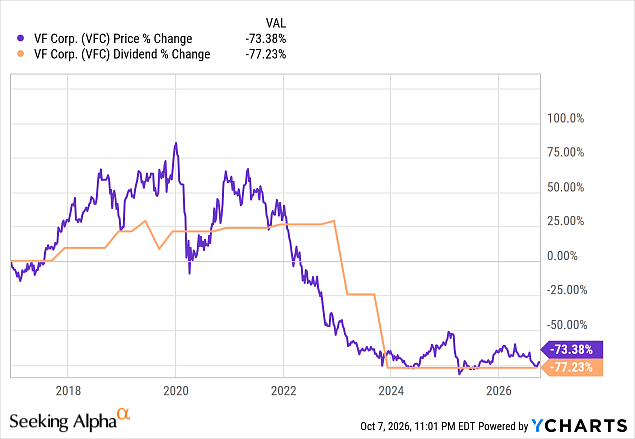
In even less drastic circumstances, we also see some serious dividend cuts. For example, V.F. Corporation (VFC
Test #2: Strong Cash Flow Cannot Always Save a Weak Balance Sheet
Another quality that I insist on is that it must have a strong balance sheet. While not as important as the first factor, this one is also extremely important. In fact, many times, dividend cuts happen because a company’s balance sheet is not strong enough, despite its dividend being sufficiently and sometimes even generously covered by cash flow.
Some examples of this include Algonquin Power & Utilities (AQN
Test #3: The Dividend Needs a Credible Path to Full Coverage
The third requirement is that it must cover its payout, either with current cash flow or have a viable path to doing so in the very near future. If the business is on sound enough footing, is defensive enough in nature, and its balance sheet is strong enough, it does not necessarily have to fully cover the payout today. However, it still needs to have a clear path to doing so in the near future. After all, if the company is overpaying the dividend, eventually something will have to give, which will usually be the dividend being reduced.
For example, Blue Owl Technology Finance (OTF
In contrast, other BDCs (BIZD
Test #4: Enough Yield to Pay Your Bills Without Falling Into a Trap
A fourth requirement needs to be that the dividend yield is high enough such that I am going to be in a position to be able to fully cover my living expenses once I retire. This will be unique for every person and depends on:
- Their current account size.
- The amount of money they’re putting away in savings every year to invest in dividend stocks.
- The time until they retire.
- Their projected living expenses in retirement
For some, the Schwab U.S. Dividend Equity ETF (SCHD
Regardless, when reaching for yield, you need to make sure you’re not compromising on these other qualities, particularly:
- The durability and defensibility of the business model.
- The strength of the balance sheet.
If you do compromise those in order to get the higher yield, you’re likely going to end up disappointed over the long term. The company may eventually be forced to cut its distribution because of a declining business model, either permanently or even just temporarily during a down cycle. It may also elect to cut the dividend or to right-size the balance sheet.
Test #5: Avoid the Hidden Dividend Cut That Inflation Delivers
Last but not least, it needs to have a track record and management’s demonstrated intent and commitment to growing the dividend over time at a rate that meets or beats inflation. Ideally, you’re going to have an investment that grows its dividend year after year like clockwork, whether it be SCHD or proven dividend growth machines, such as we’ve already mentioned, like O, NNN, and ENB.
However, there are also names out there that do not necessarily grow the dividend every year, but over time they have proven to grow the dividend fairly consistently at a rate that meets or beats inflation. Additionally, they may pay out special dividends at times, which you can reinvest to further accelerate the dividend growth process. A good example of this is Main Street Capital (MAIN
The Five Tests Behind a Retirement Portfolio I Would Actually Trust
Whether it be:
- Insisting on a durable and defensive business model.
- A strong, flexible balance sheet.
- Sufficient dividend coverage on a forward-looking basis.
- A sufficiently high yield without overreaching.
- A demonstrated commitment to, and a proven track record of, or at least a clear commitment to, dividend growth at a rate that meets or beats inflation over time.
These qualities can help investors avoid a lot of mistakes that can lead to significant disappointment.
If you buy companies that satisfy these five tests, you may or may not beat the market over time, as valuation is obviously a very important component toward that end. However, if your goal is simply to generate a source of dependable passive income that grows at a rate that meets or beats inflation over time, you are highly unlikely to be disappointed, in particular if you diversify the portfolio sufficiently. In fact, this approach will get you names like SCHD, ENB, MAIN, Enterprise Products Partners (EPD